· ReadyStack
Worked example
Real numbers from this tool, line by line.
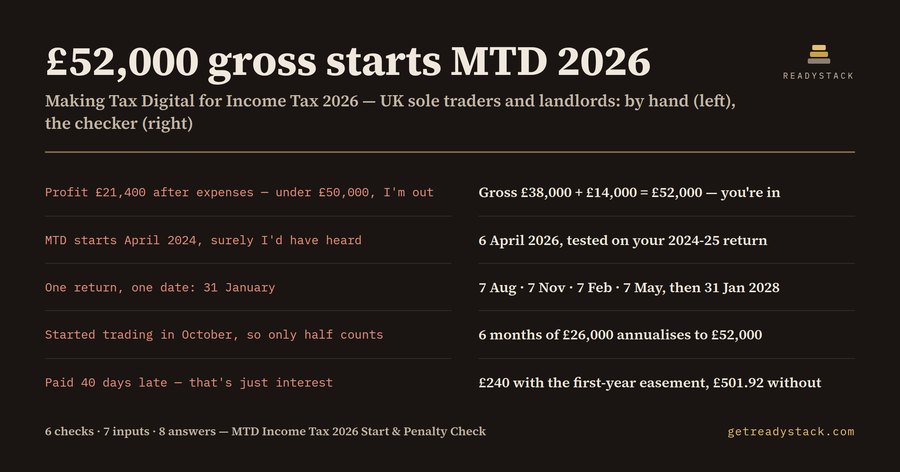
£52,000 is the number that decides it, and a Bristol sole trader who lets one flat hits it without noticing: £38,000 of self-employment turnover plus £14,000 of gross rent on the 2024-25 return. That return is the test, and it puts them inside Making Tax Digital for Income Tax from 6 April 2026, with a first quarterly update due 7 August 2026 and three more after it.
Almost everyone who gets this wrong gets it wrong the same way: they test profit. After expenses the same trader is nowhere near £50,000 and concludes they are out. HMRC's qualifying income test does not look at profit. It adds up gross receipts — turnover before expenses, plus gross rents before the mortgage interest and the letting agent. Two income streams that each look small combine into a number that is over the line.
The second way it goes wrong is the year. The threshold is not tested against the year you are in. GOV.UK is explicit: the April 2026 start was checked against the 2024 to 2025 return, the April 2027 start (over £30,000) against 2025 to 2026, and the April 2028 start (over £20,000) against 2026 to 2027. The return that decides it was filed in January 2026, and you cannot change it now. Anyone still repeating the abandoned April 2024 start date — and chatbots trained on older material still do — is answering a question that stopped existing two reschedules ago.
The third is part-year trading. If the business ran only part of the tax year, the receipts are scaled up to twelve months for the test: six months at £26,000 is tested as £52,000. A business that started in October and looks half-size on paper can be mandated on a doubled figure it never actually earned.
Then the dates, which are the part people have to live with. Quarterly updates land on 7 August, 7 November, 7 February and 7 May, and the final declaration replaces the return — for a 2026-27 start, 31 January 2028. Four dates a year instead of one.
Missing the payment costs real money on a published schedule: 3% of the tax still unpaid at day 15, another 3% at day 30, then 10% a year charged daily on what is left. On an £8,000 balancing payment that is £240, then £480, then a daily charge on top, with interest separate. There is a first-year easement that adds fifteen days before the first penalty bites, which is why the same £8,000 paid forty days late costs £240 with the easement and £501.92 without it. That is a 109% difference produced by one checkbox, and it is exactly the kind of detail a general-purpose answer will not track.
So the free checker does the whole test and keeps nothing back. You put in the two gross figures, the return year, the months traded, the tax owed and the days late, and it returns eight answers: the annualised qualifying income, the verdict against that year's threshold, the 6 April you are mandated from, the first update date, all four quarterly dates, the final declaration date, the modelled penalty, and the working that produced it. No key, no client limit, no locked results, and the popup and the web page run the same code.
The paid layer is a different axis, not a crippled version of the same one. $60 once buys ownership and repetition: export each taxpayer's dated schedule and penalty working as a .csv you keep, and set browser reminders fourteen days before every filing date. Testing one person, the free version finishes the job. Testing forty clients and then remembering four dates each is where the schedule is the thing you needed.
Thresholds and test years: GOV.UK, "Find out if and when you need to use Making Tax Digital for Income Tax".
15 seconds — what it actually does
Full walk-through
Questions people ask
What does this actually work out?
It adds your gross self-employment turnover to your gross rents, annualises them if the business ran less than twelve months, and compares that to the threshold for the return being tested. It then prints the 6 April you are mandated from, all four quarterly update dates, the final declaration date, and what a late balancing payment would cost.
Who is it for?
UK sole traders and landlords who file their own Self Assessment, and the bookkeepers and small practices who file for ten or fifty of them. If you have ever had to answer "does MTD start for this client in April 2026 or April 2027" from a folder of returns, this is the thing that answers it in seconds.
Why not just ask a chatbot or read a blog post?
Because the dates moved twice and most sources have not caught up. Chatbots still quote the abandoned April 2024 start, and many articles test profit rather than gross receipts, which flips the answer for anyone with high turnover and thin margins. HMRC's own checker wants a Government Gateway login and gives you no dates to keep.
What is free and what needs the key?
Every calculation is free and unlimited: the gross income test, the start date, the four quarterly dates, the final declaration date and the penalty model, for as many taxpayers as you like, with no key and nothing hidden. The $60 key adds exporting each schedule as a .csv you keep and browser reminders fourteen days before each date.
What would this cost me if I got it wrong instead?
HMRC charges 3% of the tax still unpaid at day 15 and a further 3% at day 30, then 10% a year charged daily. On an £8,000 balancing payment that is £480 before the daily charge starts. One missed date costs more than sixteen copies of the paid key.
Ask about this tool
One question, answered by the person who built it. Your email only if you want the answer sent.